
Supply Chains Are Being Rewired. Who Is Paying for It?
I meet a lot of manufacturers through my entrepreneur network. A few weeks ago, I was talking to one of them, and the conversation has been on my mind since.
He runs a medical equipment accessories business in Chennai. One of his larger customers, a well-known brand, had run into trouble with its regular supply chain and asked him to double his supply at short notice.
His plant could handle the volume, so production was never the issue. What he struggled with was everything that has to happen before production can start. He had to find the extra raw material, convince his vendors to supply it on credit, and arrange the working capital to pay for it. His bank limits had been set on his earlier volumes, and the brand would pay only after delivery.
So he did what most MSME owners in his position would do. He borrowed at a much higher rate than his regular working capital lines, bought the material and delivered the order.
When we spoke, he was less worried about that one order than about where this is heading. He is getting requests like this more often now. He can’t say no to a large brand, because the relationship matters too much to his business, but every time he says yes, he ends up fulfilling the order at a thinner margin, sometimes at a loss.
It got me thinking about what supplier diversification looks like from the supplier’s end.
Qualification Is Not Readiness
Diversifying suppliers is now standard practice. HSBC’s Global Trade Pulse Survey 2026 found that 88% of businesses have diversified their supplier base or are planning to. 46% already have, and another 42% plan to.
It makes sense. After the pandemic, the Red Sea disruptions and now the tariff uncertainty, no procurement head wants to depend on a single source for a critical component.
When a company qualifies an alternative supplier, it looks at capacity, quality systems, certifications and location. In medical devices the list is longer still, with ISO 13485 and regulatory audits on top. What hardly anyone checks is whether the supplier can actually fund a sudden jump in volume.
In the Chennai case, the brand had done its homework. It knew he could make the product to its standard. Nobody had asked whether he could buy twice the usual quantity of raw material with a few weeks’ notice.
The problem is, nobody usually discovers this gap until something goes wrong. By then, there isn’t much time to arrange financing.
Who Funds the Surge?
Let me put some numbers to it.
Take an illustrative example. A brand buys around $3 million a year from a secondary supplier, roughly $750,000 a quarter. Its main supplier is disrupted, and it asks the secondary supplier to double. That means an additional $750,000 of output in a single quarter.
If raw material is about 60% of the order value, the supplier needs around $450,000 just for material, and in most cases has to pay for it within the first few weeks. Labour, overtime, power and freight add another $200,000 or so over the production period.
The order is delivered in three lots of $250,000. Each lot is invoiced on delivery and paid 45 days later, which is the outer limit for MSME suppliers under the MSMED Act, though plenty of buyers take longer.
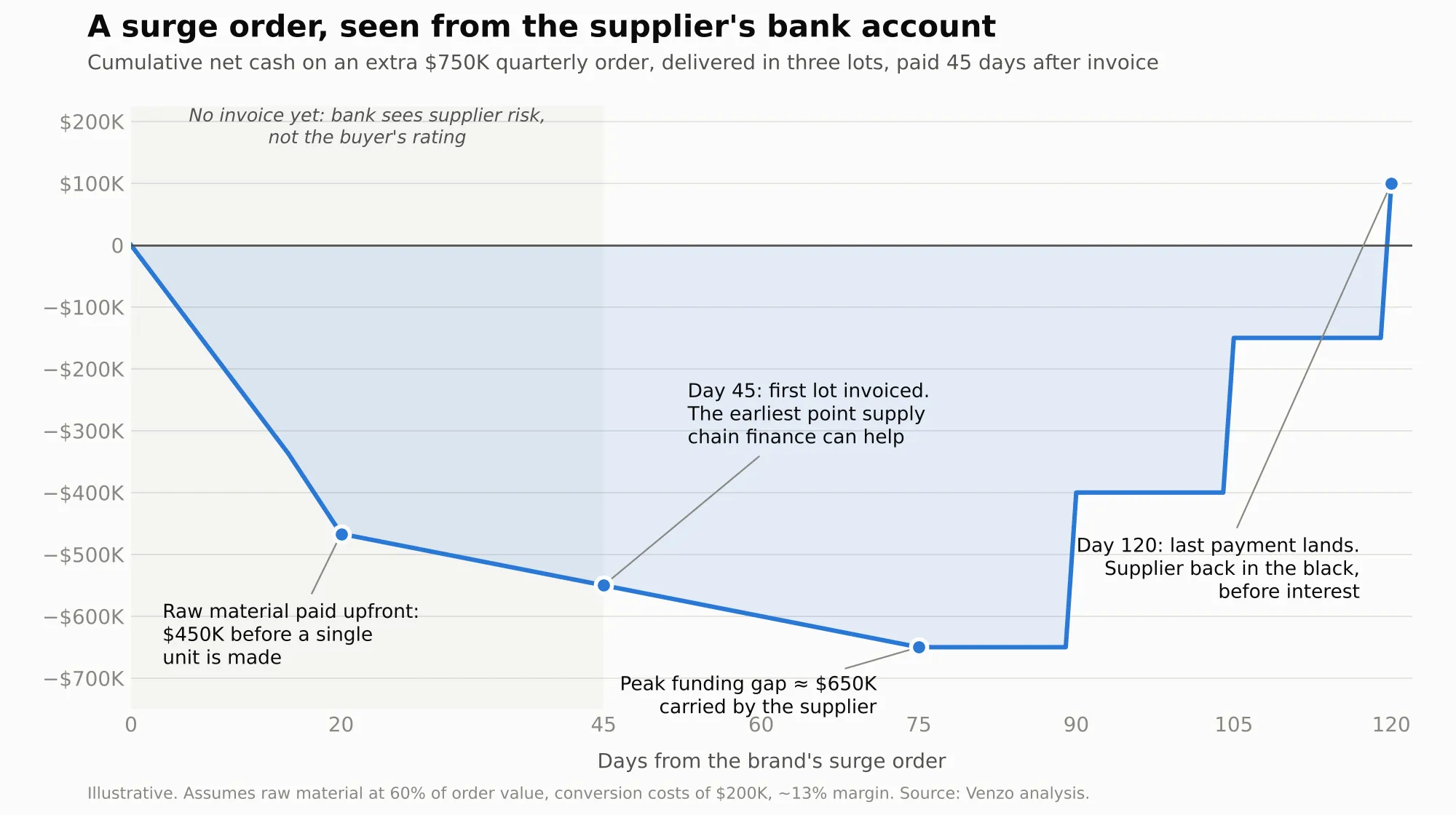
The money goes out almost immediately and only starts coming back from day 90. At the lowest point, around day 75, the supplier is carrying about $650,000 of the buyer’s order on its own balance sheet. It gets back to positive only on day 120, and that’s before counting the interest on whatever it borrowed to get there.
Meanwhile, its working capital limit was assessed on last year’s projected turnover, and no bank is going to reassess that in a week. Raw material vendors aren’t going to extend extra credit just because someone else’s customer has had a bad month either.
So the gap gets filled the way it was in Chennai, with short-term borrowing at a high rate and material bought at whatever price is going.
Here’s what that does to the margin. $500,000 borrowed at 18% for three months costs about $22,500. Paying a 10% premium for urgent material adds another $45,000. On an order earning around $100,000, roughly two-thirds of the margin is gone before you even count the overtime.
And all of this sits on the supplier’s books. The buyer never sees it.
Why Supply Chain Finance Arrives Too Late
The obvious answer is supply chain finance. If the buyer runs a payables programme, the supplier can discount its invoices against the buyer’s credit. That does help, but only once there is an invoice to discount.
Approved payables finance works against an approved invoice and, in most programmes, the buyer’s irrevocable undertaking to pay on the due date. That undertaking is what lets a bank price the supplier’s receivable on the buyer’s credit rating.
The supplier’s most urgent need, though, comes well before there is any invoice. Buying material and running production means taking supplier performance risk, the risk that the goods aren’t made, aren’t delivered or aren’t accepted, and the buyer’s rating does nothing to cover that. TReDS runs into the same wall, since it also needs an accepted invoice.
There’s another problem I’ve noticed with these programmes. Programme economics favour suppliers who generate steady, predictable financing volumes. Onboarding, KYC and documentation cost roughly the same whether a supplier discounts $50,000 a year or $5 million, so banks naturally focus on the bigger ones.
The suppliers a business will need most in the next disruption are often not the ones generating the largest financing volumes today. Quite a few of them aren’t in the programme at all.
Corporate Cash Flow Is Improving. Is Supplier Liquidity?
Two other numbers in the HSBC survey caught my attention.
59% of businesses report higher working capital requirements since 2025 because of trade and tariff uncertainty, and 75% have increased their use of alternative or short-term financing. Yet 78% say their supply chain changes have improved their cash flow and working capital.
Both numbers may well be right, but it does make you wonder how.
If corporate working capital is getting better while suppliers are borrowing expensively to keep up, some of that improvement is probably coming out of suppliers further down the chain, businesses like the one in Chennai.
Readiness Has to Be Designed, and Paid For
I think we’re mixing up two different costs here.
The first is the cost of staying ready, which means keeping capacity free, holding on to skilled workers and owning equipment that sits idle between surges. That’s a commercial decision, and it belongs in the supply contract, through minimum purchase commitments, capacity-reservation fees or volume bands priced for surge.
The second is the cost of funding a surge. That’s a credit decision, and the instruments for it already exist.
A buyer can pay an advance against an advance payment guarantee from the supplier’s bank, so its cash funds production while its risk stays covered. A bank can offer purchase-order-backed pre-shipment finance, secured by the buyer’s formal acknowledgement of the order and repaid when the invoice enters the payables programme. For exporting suppliers, packing credit can do the same job against a firm order. And where raw material is the real bottleneck, the buyer can buy the material on its own credit and hand it to the manufacturer as free-issue material, something Chennai’s automotive industry has done for decades.
Banks and corporates already use all of these. What usually doesn’t happen is anyone sitting down, before the disruption, and deciding which one fits which supplier.
For treasurers, that means treating supplier liquidity as part of supplier qualification, alongside capacity, geography and quality. It also means asking an awkward question: is your backup supplier also everyone else’s backup?
For banks, it means looking beyond which suppliers bring volume. Ask the client which suppliers would stop its production line if they failed, and make sure the programme covers those too. In our conversations with banks, this second list rarely comes up.
Venzo Perspective
Diversification gives a business options, but an option is only useful if the supplier can afford to take it up when the disruption hits.
The next step is making sure backup suppliers aren’t just sitting on the approved list, but have firm orders and funding lined up before they’re needed. If nobody pays for readiness, the risk hasn’t gone away. It has just moved to the supplier with the weakest balance sheet.
If you’ve seen a bank or corporate handle this well, I’d like to hear how they did it.
Source: HSBC Global Trade Pulse Survey 2026, pp. 9, 20–21. The dollar figures in the surge example are illustrative.