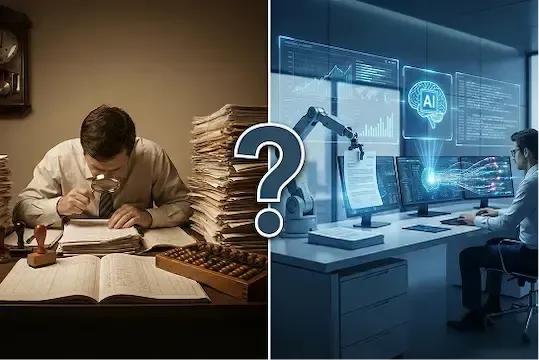
Banks are under pressure. Document volumes keep climbing. Experienced checkers are retiring faster than they can be replaced. Customers expect same-day turnarounds. And every operations head has a cost target breathing down their neck.
Meanwhile, every technology vendor promises near-perfect accuracy and a future of fully automated document checking.
So here’s the question I get asked constantly: Can AI actually replace human document checkers?
The short answer: No. Not today.
But here’s the more useful truth — AI can materially improve document checking, provided banks are honest about what it does well and where human judgment remains essential.
Document checking is thinking, not just reading
Most AI tools in trade finance handle the basics competently: ingesting documents, identifying types, extracting structured data, flagging obvious mismatches. If that were the whole job, we’d be done.
But real trade work rarely looks that clean.
Consider what checkers actually deal with:
An LC allows shipment from “Any European Port.” The BL shows Place of Receipt: Munich, Port of Loading: Hamburg, with a pre-printed “Received for Shipment” notation and a dated on-board stamp. Acceptable?
The LC calls for a “Certificate of Quality.” The document presented is titled “Inspection Report” but clearly certifies quality. Discrepant or not?
The LC states documents must not contain handwritten amendments. A forwarder makes a minor correction with a stamp. Discrepancy — or common practice?
A Certificate of Origin must be issued by a “competent authority.” It arrives from ABC Inspection Company. Equivalent — or not?
These aren’t data-extraction problems. They’re judgment calls — the kind that require understanding intent, context, and precedent. Today’s AI struggles to reason through these reliably without heavy supervision.
The industry itself can’t agree
Here’s an uncomfortable reality: document checking isn’t standardised.
Unlike payments or AML screening, two banks can interpret the same clause differently. Two teams within the same bank sometimes reach different conclusions.
Why? Because checking depends on LC wording, interpretation of UCP and ISBP, local market practices, historical audit findings, risk appetite, and customer relationships.
The industry knows this. That’s why the ICC runs DOCDEX — a formal dispute-resolution mechanism for documentary credits. In 2024, the ICC registered 841 arbitration cases and issued over 350 expert opinions to resolve documentary disputes.
One example: An LC called for shipment of 400 MT in 8 containers, with partial shipment allowed. The first presentation (130 MT in 3 containers) was honoured. The second (200 MT in 5 containers) was refused. The issuing bank argued the full quantity wasn’t shipped. The beneficiary’s bank argued partial shipments were explicitly permitted.
If experienced professionals with rules, precedents, and decades of practice still disagree at this level, expecting AI to auto-resolve every case is wishful thinking.
AI thrives on consistency. Trade finance lives on exceptions.
Where AI delivers value today
Used properly, AI already makes a real difference:
Document intake and classification — quickly identifying missing documents and sorting large presentations.
Structured data extraction — BL numbers, dates, quantities, vessels, HS codes, Incoterms.
First-level discrepancy checks — cross-document comparisons and LC-to-document validations.
Fraud and anomaly detection — spotting unusual patterns across shipments, vessels, routes, or document templates.
Done well, this removes 30–50% of the mechanical effort from a checker’s day.
The banks seeing results aren’t trying to replace checkers. They’re redesigning the workflow: AI extracts and compares, humans assess logic and context, exceptions get escalated, and repeated decisions get standardised over time.
Ironically, forcing full automation on exception-heavy trade flows often increases turnaround time and operational risk.
Different products need different approaches
Treating all trade products the same is a mistake. Risk profiles differ. Exposure differs. The checking model should too.
| Product / Scenario | Risk | Document Profile | Recommended Model |
|---|---|---|---|
| Documentary Collections | Low | Standardised, predictable | High automation, limited review |
| Import LCs — Standard Wording | Medium | Familiar structures | AI-led, value-based human review |
| Import LCs — Non-Standard Wording | High | Custom clauses, special conditions | Human-led with AI support |
| Confirmed Export LCs | Very High | High bank exposure | Fully human-driven |
| Unconfirmed Export LCs | Medium | Lower exposure | AI-assisted human checking |
Venzo perspective
AI won’t eliminate document checkers. What it will eliminate is manual document handling.
Banks that succeed with AI in trade will redesign operations around data-first documents, clear templates, explicit decision rules, human-AI collaboration, and exception-driven workflows.
The goal isn’t fewer checkers. It’s better use of checker time — less on mechanical tasks, more on risk assessment, context, and commercial judgment.
That’s where AI becomes a genuine enabler, not a replacement.